5/8″ Nylon Lead Rope with Braided Loop #ALR5
$26.00
Description: This 5/8″ Nylon Lead Rope with Braided Loop #ALR5 is made of white medium lay 5/8 inch nylon rope with an eye loop that’s hand braided/spliced in. The tail is braided back to prevent unraveling. The nylon is 10 feet before braiding, making it approximately 8 ft. 6 in. when it’s finished. The 5/8 inch nylon makes a good, stout, lead rope with plenty of flexibility to tie easily. You can read how to properly tie a lead rope by clicking: Take Me To Your Lead Rope.
Related products
-
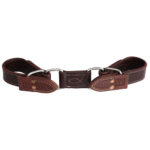
No Buckle Hobble with Leather Center #H3L
$105.00Description: This No Buckle Hobble with Leather Center #H3L is made of 1 3/4 inch doubled and stitched latigo leather. It has a 3 inch long latigo leather link in the center to separate your horse’s legs. The rings and squares are made of smooth stainless steel. This hobble has an easy “on/off” latch that makes it so quick and simple to take on and off your horse’s fetlocks. This should only be used on horses that are completely hobble broke.
Visit “Hobble Along” to read my Tack Talk article on the safe and proper use of hobbles.
Only for use on horses that are hobble broke.
-

String Running Martingale #CM4
$48.00Description: The String Running Martingale #CM4 is made of tan 1/4 inch nylon cord. The rings and swivel snap are stainless steel. The safety hobble strap goes through the gullet of the saddle and over the horn to prevent the neck strap from sliding to the ears. This martingale is adjustable both around the neck and to the cinch.
How it works: The running martingale is a very useful tool to aid a horse in learning proper head position as he learns collection. If adjusted correctly a martingale does not force the head to stay in any given position but allows the horse a guide for head placement through automatic release of pressure on the reins when correct head placement is achieved. This can make it easier for a horse to reach a more collected frame over time by allowing assistance with head position as rider teaches the horse to drive from behind.
A good rule of thumb for adjustment is to allow horse to stand comfortably, attach snap to cinch D ring and extend ring straps until they reach the throatlatch.
-

Leather Tiedown Strap #ZG
Price range: $67.00 through $72.00Description: Our Leather Tiedown Strap #ZG comes in both 3/4 inch and 1 inch widths (see dropdown). Both sizes are fully adjustable and made of single ply harness leather that has been edged, hand rubbed, treated with Neatsfoot Oil and hand rubbed again. Snaps and roller buckle are stainless steel. These are top of the line tiedown straps that you will be able to use for many years of hard daily work without problems.
-

Sidepull #CP38
$199.00Description: The noseband on the Sidepull #CP38 is made of 3/8 inch firm nylon rope specially designed to lay correctly from the first ride. The headstall is made of single ply, 3/4 inch, dense, tight-fibered harness leather and has a 5/8 inch throat latch. The leather has been edged, hand-rubbed, oiled with Neatsfoot Oil and hand-rubbed again. The buckles and rings are all stainless steel.
Reins: If you’d like to purchase reins for your Sidepull some of our most popular choices are the #ASR6 DM Harness Leather Split Reins, or the #BLL1 Latigo on Latigo 5/8″ medium weight reins. At 6 1/2 to 7 feet either of these reins will work well on the smaller colt or horse. At 7 to 7 1/2 feet, the #ASR3 XX Harness Leather Split Reins are a good choice for the bigger colt or horse (generally 15 to 16 hands). Many of our other reins can also be used on this Sidepull. Visit the rein category to purchase your choice of reins separately.
How it works: Sidepulls are a good piece of equipment to use for starting colts, or to transition colts to from a soft rope hackamore. Using a sidepull is a nice way to teach young horses to move through turns with their noses first without putting any pressure on their delicate mouths. Once the colt is turning well with direct pressure from the sidepull a trainer will move to the snaffle, hackamore or bosal.
Sidepull is shown with the #BLL1 Latigo on Latigo 5/8 inch Medium Wt 7 ft Reins.
-

No Buckle Hobble with Chain Center #H3C
$102.00Description: This No Buckle Hobble with Chain Center #H3C has an easy “on/off latch” that makes it a snap to take on and off your horse’s fetlocks. It is 1 3/4 inches wide and made of doubled and stitched latigo leather. The smooth stainless steel chain link in the center makes it more flexible than similar hobbles with leather centers such as the #H3L No Buckle Hobble. This should only be used on horses that are completely hobble broke.
Visit “Hobble Along” to read my Tack Talk article on proper and safe use hobbles.
For use only on horses that are hobble broke.