Double Rope Noseband/Tiedown #T3
Price range: $121.00 through $193.00
Description: This Double Rope Noseband/Tiedown #T3 is made of 2 pieces of 3/16 inch nylon rope with a stainless steel dog-bone. Latigo leather covers the nose and is laced on the noseband with rawhide laces. The leather hanger has been edged, hand rubbed, treated with Neatsfoot Oil and hand rubbed again. The buckle is stainless steel. The leather beneath the buckle is stitched together to keep the buckle in place when you adjust the hanger.
How it works: This double rope noseband is wider than any of my single rope nosebands. The width spreads the contact pressure over a larger area of the nose. That, in conjunction with the leather on the noseband, makes this milder than my nosebands that are covered in braided rawhide but it gives a stronger signal than my Leather Noseband/Tiedown.
This tiedown noseband will hold up to years of hard use.
This noseband is available without a tie down strap or with your choice of a 1 inch or 3/4 inch Leather Tie Down Strap #ZG or a Nylon Tiedown Strap #ZH (see dropdown). Also shown on the horse is the Harness Leather Roping Reins with Rawhide Knots #RR24.
Related products
-

String Running Martingale #CM4
$48.00Description: The String Running Martingale #CM4 is made of tan 1/4 inch nylon cord. The rings and swivel snap are stainless steel. The safety hobble strap goes through the gullet of the saddle and over the horn to prevent the neck strap from sliding to the ears. This martingale is adjustable both around the neck and to the cinch.
How it works: The running martingale is a very useful tool to aid a horse in learning proper head position as he learns collection. If adjusted correctly a martingale does not force the head to stay in any given position but allows the horse a guide for head placement through automatic release of pressure on the reins when correct head placement is achieved. This can make it easier for a horse to reach a more collected frame over time by allowing assistance with head position as rider teaches the horse to drive from behind.
A good rule of thumb for adjustment is to allow horse to stand comfortably, attach snap to cinch D ring and extend ring straps until they reach the throatlatch.
-

German Martingale Complete #CM1A
$527.00How it works: The key to any German Martingale is the release of pressure on the bit. The Y-cord on my German Martingale is made with a very tightly braided cord with a hard finish. This cord runs from the cinch, through the rings of the bit and connects to the reins at the Y cord rein knot (please see diagram). This cord releases immediately, with no drag, when you release finger-tip pressure on the reins. The horse learns to respond to pressure on the bit from this quick and rewarding release.
The neck strap on my German Martingale is long to give the correct angle from the cinch to the bit. This angle is very important in the training process because it encourages a horse to lower its neck from the withers before flexing at the poll. You will not find this angle on other German Martingales. The safety hobble on the neck strap goes through the gullet and over the horn to prevent the neck strap from sliding forward and getting caught behind the ears. Without the safety hobble pressure from the martingale sliding forward may cause a horse to rear up and possibly fall over backwards.
There is only one simple adjustment on my German Martingale; the adjustment knot that leads to the cinch snap. This can be adjusted so this Martingale fits any size horse correctly. This is a great tool to use on any age horse. It helps relax and collect a horse and helps eliminate dropped shoulders in preparation for advanced maneuvers.
A German Martingale needs to be used correctly and with caution. Always check a horse from the ground so they know the German Martingale is there before you get on. Do not let the horse drop its head to the ground because he can step through the martingale rein and cause an accident. When you dismount, immediately unsnap the martingale from the cinch.
Description: The complete German Martingale includes the #HS24 3/4″ Browband Headstall, your choice of the #17-9 Heavy Ring Snaffle with 3/8th inch 2 piece mouthpiece, the #17-42 Heavy Ring Snaffle with 3/16th inch twisted wire mouthpiece or the #18 Egg Butt Snaffle and your choice of 3 harness leather reins. The choice of reins includes: the #ASR6 DM Harness Leather Split Reins which are 6 1/2 to 7 feet and work well on the smaller horse, the #ASR3 XX Harness Leather Split Reins which are 7 to 7 1/2 feet and are a good length for the average horse of 14.2 to 16 hands, and the #ASR2 XXX Harness Leather Split Reins are 7 1/2 to 8 feet and work well on horses 16 hands and over.
Also shown on the horse is the #CA1 3/16th” Rope Cavesson with Rawhide Braided Nose. This cavesson is sold separately and not included in the price of the German Martingale.
Assistance from a professional is necessary to learn safe use of a German Martingale. If you’re not familiar with the proper use of a German Martingale, get the help of a professional trainer who is experienced with its use.
-

Chuck Frasier Sidepull #CP40
$271.00Description: The noseband on this sidepull is crafted from firm 3/8″ nylon rope, which is specially designed to ensure it lays correctly from the first ride. The headstall is made of single ply 3/4″ tight-fibered harness leather with a 5/8″ throat latch. This sidepull comes with slot conchos which are the safest and most secure conchos available. You can see the photos on the left for instructions on slot concho removal and application. The buckles on this Chuck Frasier Sidepull #CP40 are stainless steel with the leather below the buckles stitched to keep them in place.
How it works:
Since this sidepull is considered a bitless bridle, it is designed for use on the adult horse and is a great tool to avoid putting pressure on the horse’s mouth while maintaining plenty of control. With the design of this sidepull, the stainless-steel shanks come against the opposite side of the horse’s face with a direct rein pull so the horse starts his turns without leaning. Put your leg on him once the turn is started to teach him to complete the turn without leaning. The noseband in combination with the dog chain curb provides a strong signal to stop.Watch the video “The Secret to using the Chuck Frasier Sidepull” to learn more.
Shown with ASR3 XX Harness Leather Split Reins.
-
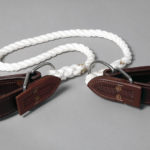
Bill Riddle Sideline #SL2
Price range: $97.00 through $106.00Description: The Bill Riddle Sideline #SL2 is made of two doubled and stitched burgundy latigo leather cuffs with easy on/easy off closures. These cuffs are 1 3/4 inch wide and connected by your choice of 24, 30 or 36 inch (see dropdown) pieces of soft white nylon rope. The rectangles and Dees are made of smooth round stainless steel rod.
How it works: This is a very helpful piece of equipment to use when you are sacking out a colt, teaching a young horse to stand hobbled or wanting to keep a horse from kicking in the trailer. You can prevent a horse that kicks in the trailer from hurting himself or damaging the trailer by using this sideline on just the left side or right side legs or use two sidelines and cross them between the legs. Sidelines and hobbles can both have a quieting effect on a horse’s mind.
The first time you use the sideline on your horse or while training the horse to accept them use a wide open sandy area. Do not put it on in the trailer or other confined space until they accept the sideline easily and well.
-
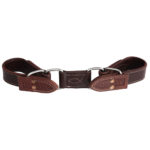
No Buckle Hobble with Leather Center #H3L
$105.00Description: This No Buckle Hobble with Leather Center #H3L is made of 1 3/4 inch doubled and stitched latigo leather. It has a 3 inch long latigo leather link in the center to separate your horse’s legs. The rings and squares are made of smooth stainless steel. This hobble has an easy “on/off” latch that makes it so quick and simple to take on and off your horse’s fetlocks. This should only be used on horses that are completely hobble broke.
Visit “Hobble Along” to read my Tack Talk article on the safe and proper use of hobbles.
Only for use on horses that are hobble broke.