Kick Chain #KC1
$67.00
Description: The Kick Chain #KC1 is made of doubled and stitched 1 3/4 inch burgundy latigo. It has a leather cuff that fastens to a rectangle to secure it to the fetlock. The rectangle, dee and 12 inch chain are all smooth stainless steel. This kick chain is made to fit the front or back fetlock of any size horse.
How it works: This is an ideal aid for horses that want to kick or paw while in the stall or trailer, or paw while tied up. It can be fastened to either a front or hind fetlock. Most horses will stop pawing or kicking after a short time with the kick chain but a small percentage will need to wear it indefinitely. Generally, one kick chain can be used for a session and then transferred to the other front or back fetlock for a session and the problem will be solved. Occasionally a horse that has been pawing or kicking for a long time will need to wear a kick chain on both legs at the same time.
This is sold as a single kick chain. If you need more than 1 please order additional kick chains in the ”quantity” box.
This is not a tool to be used for teaching horses to not kick at people.
Shown on a horse that is 15.1 hands and 1100 pounds.
Related products
-

German Martingale with Split Reins #CM1C
$202.00Description: The German Martingale with Split Reins #CM1C is the same as the German Martingale Complete #CM1A but without headstall or bit. The martingale is made of 1/4 inch tan nylon cord and comes with your choice of 3 harness leather reins: #ASR6 DM Harness Leather Split Reins are 6 1/2 to 7 feet long and work well on smaller horses, the #ASR3 XX Harness Leather Split Reins are 7 to 7 1/2 feet long and a good choice for horses 14.2 to 16 hands and the #ASR2 XXX Harness Leather Split Reins are 7 1/2 to 8 feet long and work well for horses 16 hands and over. See dropdown to order.
How it Works: The key to the German martingale is the long neck strap giving a good line from the bit to the cinch. This allows the neck to lower from the withers before flexing at the poll. The 1/8 inch solid braid cord that runs through the bit to the reins has a high quality hard finish so slides very easily allowing a quick release. The release is more important than the pull but you have to pull to get the release. A horse learns from the release. The safety hobble strap attached to the neck strap goes through the gullet of the saddle and over the horn to prevent the neck strap from sliding to the ears.
Assistance from a professional is necessary to learn safe use of a German martingale.
The martingale is a very useful tool to aid a horse in learning proper head position as he learns collection. If adjusted correctly a martingale does not force the head to stay in any given position but allows the horse a guide for head placement through automatic release of pressure on the reins when correct head placement is achieved. This can make it easier for a horse to reach a more collected frame over time by allowing assistance with head position as the rider teaches the horse to drive from behind.
The labeled diagram shows the Complete German Martingale #CM1A. This German Martingale with Split Reins #CM1C is the same but comes without headstall and bit.
-
Bronc Sideline #SL1
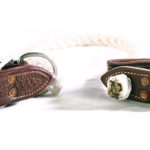
$97.00Description: The cuffs on this Bronc Sideline #SL1 are made of 1 3/4 inch doubled and stitched burgundy latigo leather with a leather tab fastener for easy connection and release. The rectangle and Dee are made of smooth round stainless steel rod. The cuffs are connected with 1/2 inch by 24 inch nylon rope. This’ll be one of the handiest tools you’ll ever use.
How it works: To apply the Bronc Sideline just build a loop in the back of the cuff by sliding the rope through, let the colt step in it and pull it snug. Let him settle and then attach the easy-on front cuff. Always use caution when putting the sideline on for the first time. Get out in an open sandy arena with lots of room so your colts or horses will be safe if they react to having their legs connected with the sideline. Once horses learn how a sideline feels they usually accept it and stand quietly. Both sidelines and hobbles can have a very quieting effect on the horse’s mind.
The first time you use the sideline on your horse or while training the horse to accept it use a wide open sandy area. Do not put it on in a confined space until they accept the sideline easily and well. If you are not familiar with the use of sidelines seek help from a professional who is experienced with their use.
-
German Martingale with Roping Rein #CM1D
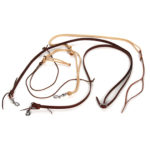
$126.00Description: The German Martingale with Roping Rein #CM1D is the same as the German #CM1A but comes with a roping rein instead of split reins. This martingale has no headstall or bit so you can add your own. The martingale is made of 1/4 inch tan nylon cord with a 1/2 inch latigo safety hobble strap. The roping rein has been edged, hand rubbed, oiled with Neatsfoot Oil and hand rubbed again.
How it Works: The key to the German martingale is the long neck strap giving a good line from the bit to the cinch. This allows the neck to lower from the withers before flexing at the poll. The 1/8 inch solid braid cord that runs through the bit to the reins has a high quality hard finish so slides very easily allowing a quick release. The release is more important than the pull but you have to pull to get the release. A horse learns from the release.
Assistance from a professional is necessary to learn safe use of a German martingale.
The martingale is a very useful tool to aid a horse in learning proper head position as he learns collection. If adjusted correctly a martingale does not force the head to stay in any given position but allows the horse a guide for head placement through automatic release of pressure on the reins when correct head placement is achieved. This can make it easier for a horse to reach a more collected frame over time by allowing assistance with head position as the rider teaches the horse to drive from behind.
The diagram shows the Complete German Martingale #CM1A. This German Martingale #CM1D comes with a roping rein and without headstall or bit.
-

1″ Hobble #H1
$85.00Description: This 1″ Hobble #H1 is made of doubled and stitched burgundy latigo leather. The buckle is a stainless steel square top roller buckle and the rings are stainless steel. It is small enough to hang on your saddle rear D and stout enough to last for years.
How it works: This hobble works especially well for sacking out colts and patience training when used in combination with the #SL1 Bronc Sideline (shown on horse in picture). Hobbles are very good for teaching patience, trust in the handler, and responding correctly to pressure.
Many horses have been saved from severe injury when caught in wire because they were hobble trained. A horseman may also teach his or her horse to accept hobbles and sidelines so it won’t need to be tied or ground tied. When a horse is hobbled it won’t hurt its mouth with a jerk from a stepped on or looped rein. Hobbles and sidelines can also have a quieting effect on the horse’s mind. Investing in hobbles and their training can have big pay-backs.
To put a set of hobbles on:
1. Starting with the right front leg, wrap the end of the hobble strap clockwise around the leg and lace it through the first metal ring.
2. Lace the strap through the second ring.
3. Run the strap behind the left front leg.
4. Buckle the strap.
For more information on hobbles read my Tack Talk Article Hobble Along.
The first time you use the hobbles on your colt or horse, or while training the horse to accept hobbles, use a wide open sandy area. Do not put hobbles on in a confined space until they accept them easily and well. If you are not familiar with the use of hobbles seek help from a professional who is experienced with their use.
-

Above the Hock Kick Chain #KC2
$78.00Description: The Above the Hock Kick Chain #KC2 is made of 1 inch double and stitched latigo leather with a stainless steel roller buckle and dee. The 18 inch chain attached to the dee is also stainless steel.
How it works: It is attached above the hock. Placement above the hock eliminates the chain being drug around the stall. This is a useful tool for horses that want to kick the stall or trailer. Most horses will stop kicking after a short time but a small percentage will need to wear a kick chain indefinitely. This kick chain is sold as a single. If you need additional Above the Hock Kick Chains, and you may need 1 for each back leg on a horse that has been kicking the stall or trailer for an extended time, please order additional in the “quantity” box.
This is not a tool to be used for teaching horses to not kick at people.
Shown on a horse that is 15.1 hands and 1100 pounds.