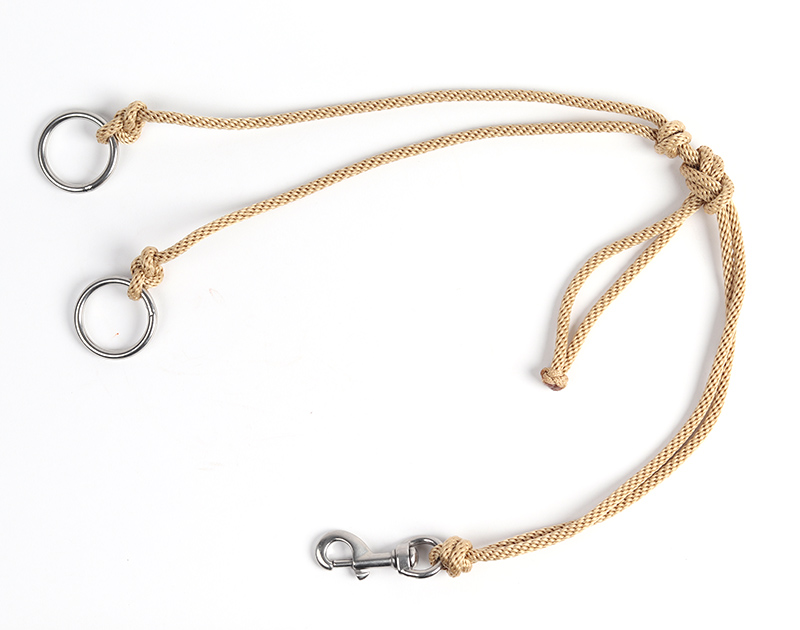
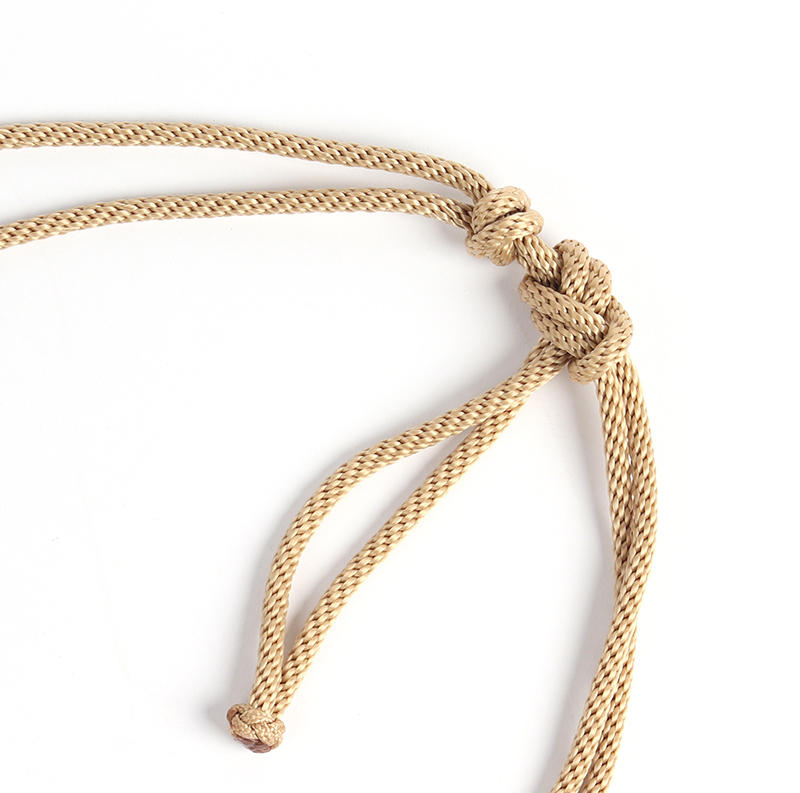

Training Fork #CM7
Price range: $36.00 through $46.00
Description: This adjustable training fork is made of tan 1/4 inch solid braid nylon rope with a 1 1/2 inch stainless steel ring tied to each end for a rein to run through. A stainless steel snap attaches it to the cinch.
How it works: A training fork helps horses learn to carry their heads in the proper position to allow them to drive from behind and improve collection. The training fork will apply pressure to the reins and bit anytime the horse’s head rises. You simply adjust the length of the cord that connects to the cinch to place the training fork rings in the correct position for each horse you’re riding. Learn more about training fork and running martingale adjustment here: Running Martingale Adjustment and Use-Keep it Safe.
Do not let the horse drop its head to the ground because it can step on the rein or training fork and cause an accident. Whenever a training fork is used, rein stops need to be used on the reins. Rein Stops will prevent the rings on the training fork from getting caught on the rein ends. Rein stops can be ordered in the dropdown.
Related products
-

Above the Hock Kick Chain #KC2
$78.00Description: The Above the Hock Kick Chain #KC2 is made of 1 inch double and stitched latigo leather with a stainless steel roller buckle and dee. The 18 inch chain attached to the dee is also stainless steel.
How it works: It is attached above the hock. Placement above the hock eliminates the chain being drug around the stall. This is a useful tool for horses that want to kick the stall or trailer. Most horses will stop kicking after a short time but a small percentage will need to wear a kick chain indefinitely. This kick chain is sold as a single. If you need additional Above the Hock Kick Chains, and you may need 1 for each back leg on a horse that has been kicking the stall or trailer for an extended time, please order additional in the “quantity” box.
This is not a tool to be used for teaching horses to not kick at people.
Shown on a horse that is 15.1 hands and 1100 pounds.
-

Adjustable String Cavesson #CA2
$43.00Description: The noseband on this Adjustable String Cavesson #CA2 is made of tan 1/8 inch solid braid nylon cord. The adjustment knots at the bottom allow the noseband to be quickly changed between horses to 19, 21 or 23 inches. The headstall is made of 1/2 inch burgundy latigo leather that has been edged and hand-rubbed. The buckle is beveled stainless steel with a leather loop keeper. This cavesson lays flat under your bridle and will last for years of hard use.
Size Measurement: An easy way to be certain this cavesson will fit is to wrap a leadrope around the nose where the cavesson will lay, mark the leadrope with a magic marker, straighten it and then measure the leadrope. When measuring, be sure to wrap the leadrope loosely enough that the horse will have enough room between his nose and the cavesson to be comfortable and to be able to hold the bit. A good rule of thumb is 2 fingers width between the nose and cavesson (which is the diameter of most leadropes) if the horse is trained to a cavesson.
This cavesson is a good all-around cavesson and can be used on colts if adjusted loosely when starting them in it.
For more information on cavesson fit and use visit: There’s More to a Cavesson than Meets the Eye: How and Why to Use Cavessons
-

Kick Chain #KC1
$67.00Description: The Kick Chain #KC1 is made of doubled and stitched 1 3/4 inch burgundy latigo. It has a leather cuff that fastens to a rectangle to secure it to the fetlock. The rectangle, dee and 12 inch chain are all smooth stainless steel. This kick chain is made to fit the front or back fetlock of any size horse.
How it works: This is an ideal aid for horses that want to kick or paw while in the stall or trailer, or paw while tied up. It can be fastened to either a front or hind fetlock. Most horses will stop pawing or kicking after a short time with the kick chain but a small percentage will need to wear it indefinitely. Generally, one kick chain can be used for a session and then transferred to the other front or back fetlock for a session and the problem will be solved. Occasionally a horse that has been pawing or kicking for a long time will need to wear a kick chain on both legs at the same time.
This is sold as a single kick chain. If you need more than 1 please order additional kick chains in the ”quantity” box.
This is not a tool to be used for teaching horses to not kick at people.
Shown on a horse that is 15.1 hands and 1100 pounds.
-
Adjustable Latigo Leather Cavesson #CA5
Price range: $80.00 through $86.25Description: This Adjustable Latigo Leather Cavesson #CA5 is made with a doubled and stitched 5/8 inch burgundy latigo leather noseband. The chin strap and headstall are single ply burgundy latigo leather. This latigo is a soft, pliable leather that feels good on a horse’s face. It’s stout and will last for years of hard use. The buckles and rings are stainless steel. This cavesson is available in small and large sizes. Both sizes are adjustable. The noseband on the small cavesson adjusts between 20 1/2 and 24 inches and the crown adjusts between 30 and 33 inches. The noseband on the large cavesson adjusts between 23 and 27 inches and the crown adjusts between 31 and 38 inches. Generally speaking, the small size will fit the smaller or young horse (approximately 14.2 hands and under) and the large size will fit the mature/bigger horse over 14.2 hands.
Size Measurement: An easy way to be certain to get the correct sized cavesson is to wrap a leadrope around the nose where the cavesson will lay, mark the leadrope with a magic marker, straighten it and then measure the leadrope. When measuring, be sure to wrap the leadrope loosely enough that the horse will have enough room between his nose and the cavesson to be comfortable and to be able to hold the bit. A good rule of thumb is 2 fingers width between the nose and cavesson (which is the diameter of most leadropes) if the horse is trained to a cavesson.
This cavesson is a good starting cavesson and is also good for sensitive horses. It should be adjusted loosely when starting any horse in it.
For more information on cavesson fit and use visit: There’s More to a Cavesson than Meets the Eye: How and Why to Use Cavessons
-
Sliding Running Martingale #CM3
$95.00Description: The Sliding Running Martingale #CM3 has a 3/4 inch adjustable neck strap made of heavy harness leather. Each end of the neck strap is stitched to a stainless steel ring. An adjustable tie down strap is sewn to the center of the neck strap ring on one end and snapped to the cinch on the other end. A second snap with a ring-end is snapped to the opposite side of the center ring of the neck strap. A heavy 1/4 inch nylon cord runs through the ring end of the snap. The nylon cord is 18 inches long and has rein rings at each end. An 1/2 inch latigo leather safety hobble strap with a slit on one end runs from the neck strap through the gullet of the saddle and over the horn. This safety hobble strap prevents the neck strap from sliding to the ears.
How it works: Running martingales are very useful tools to aid horses in learning proper head position as they learn collection. With this martingale, the sliding action of the nylon cord, occurring when the rider pulls on either rein, helps your horse maintain a correct frame as his head turns. If adjusted correctly a martingale does not force the head to stay in any given position but allows the horse a guide for head placement through automatic release of pressure on the reins when correct head placement is achieved. This can make it easier for a horse to reach a more collected frame over time by allowing assistance with head position as the rider teaches the horse to drive from behind.