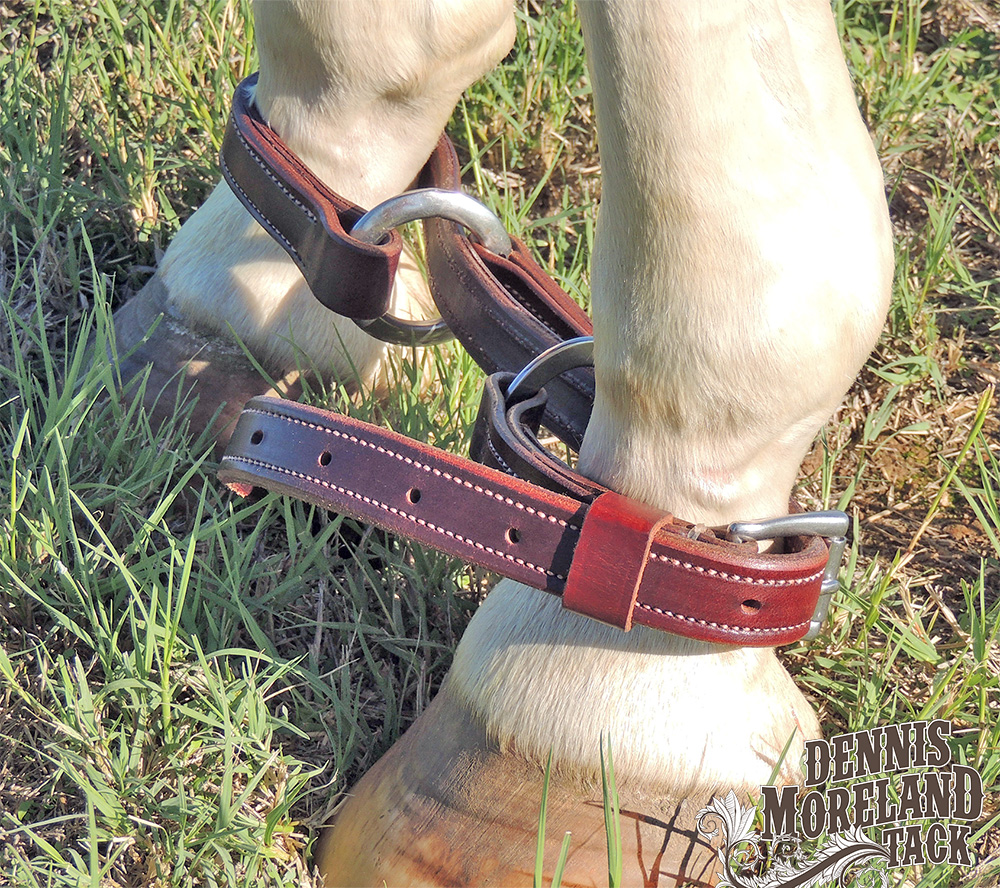
At Dennis Moreland Tack we recommend teaching your horses to accept being hobbled. Hobbling helps a horse learn not to fight against being restrained. It’s another form of desensitizing or sacking out horses and can really help keep your horse safe if it ever gets anything tangled around a leg.
“When I was young and working on the ranch I turned an older horse out when it was snowing and the herd started playing” says Dennis. “I heard the wire fence creak. I hurried to check and this horse had slipped and was upside down with his hocks in the barbed wire and both hind shoes in the net wire. He could have cut his legs had he fought that wire but he had been hobble trained and he laid there and never moved. I had to go get him up. Young or old, horses need to understand what hobbles are.”
Introduce hobbles safely. Use a sandy round pen or another area that has soft footing with nothing for the horse to get caught in.
When teaching foals, you can wrap a soft cotton lead rope above the knees with a twist in the middle that you can hold on to and let go of as needed. Young horses have soft bones and you don’t want to do too much. For training mature horses place the soft cotton rope around the pasterns or ankles with the same twist in the middle. Once they accept this rope, which is generally fairly quickly, the leather hobbles can be used.
“I prefer a figure 8 hobble, which is the shape of the hobble when it’s on a horse’s legs, and I like to have a long tail for training. When it’s on the horse you’re going to have a lot of tail hanging, but if you have a colt that is squirming, you can buckle one of the first holes and gradually tighten it as the colt settles down” says Dennis. We make the 1 1/4″ Hobble #H11 specifically for training young horses.
Be sure to keep the distance between the middle rings or Ds on your hobbles close. If you leave 8-10 inches between the horse’s legs he can learn to run with the hobbles and that defeats their purpose. Approximately 4-6 inches is a safe amount of space.
Hobbles made out of nylon should be avoided. They often have sharp edges that can cut a horse’s legs.
A horse taught to accept being hobbled will give to pressure and understand release, will be more likely to be still if caught in wire, is easily secured when there’s no place to tie and will not have his mouth or neck jerked by a tied or stepped on rein. Hobble training can have huge pay-backs. A hobble broke horse is a safer horse!
All of the hobbles at Dennis Moreland Tack are made of soft but strong latigo leather and stainless steel hardware. Latigo is more resistant to heat, and has more cushioning and flexibility than other leathers. Only stainless steel hardware is used. Chrome and brass deteriorate and can rot the leather where it folds around buckles or rings. This causes a safety hazard that can be hard to see. Check out our selection of handmade figure eight hobbles. Style used just comes down to personal preference. Please call 832-529-9226 or email info@dmtack.com if you have questions.
We’re a full line manufacturer of handmade tack and we’re here to help you!